Knowing how to pack a home library for moving is one of the most consistently underestimated challenges in any residential relocation. From the doorway, the room can look almost self-contained — rows of books on shelves, a comfortable reading chair, perhaps a rolling ladder and a few framed prints. But once you commit to a genuine, methodical inventory, the full complexity comes into focus: hundreds or thousands of books whose combined weight can easily exceed the safe limit of any standard moving box, tall bookcases that must be fully emptied and properly disassembled before they can be safely moved, rare or antique volumes that require archival-quality packing rather than newspaper and tape, framed artwork and maps hung at precise positions for lighting reasons, delicate collectibles — vintage globes, ceramic bookends, limited-edition figurines — that are nestled between books and just as fragile as anything in the china cabinet, and a carefully cultivated organizational system that took years to build and that will take far longer than expected to reconstruct if it is not documented before the first book leaves the shelf. Pack a home library without a deliberate plan and you risk arriving at your new home with warped book spines, damaged dust jackets, cracked frames, shelves that cannot be rebuilt without the hardware that got lost, and the dispiriting prospect of re-sorting an entire collection from scratch.
Why the Home Library Requires Its Own Packing Strategy
The home library occupies a genuinely unusual position among all the rooms in a house. It is not defined by appliances or fragile dishware, and it does not contain the hazardous materials that complicate a garage or shed. Instead, it is defined by a single overriding challenge that is easy to underestimate: sheer cumulative weight combined with the fragility of individual items that do not look fragile at first glance. A single hardcover book weighs relatively little. Two hundred of them packed into the same box can collapse the box, injure a mover's back, and damage the books themselves through pressure and shifting during transport.
There are four specific reasons home library packing goes wrong more often than people expect:
- Books are heavier than they look in aggregate: A standard large moving box filled with books can weigh 60 to 80 pounds or more — well beyond what most movers consider a safe single-person lift, and far more weight than the box bottom was designed to hold. Overfilled book boxes split at the seams, drop their contents, and create injury risk on loading day. Small and medium boxes, packed strategically and sealed with extra tape on the bottom, are the only safe approach.
- Organizational systems are invisible to everyone but the owner: A home library often has a logical arrangement — by subject, author, acquisition order, reading priority, or some personal combination of all of these — that looks like random shelving to anyone else. Once books are removed from shelves and packed into unlabeled boxes, that system is gone. Rebuilding it from memory in a new space is far more labor-intensive than photographing and sectioning shelves before packing begins.
- Rare, antique, and signed books need specialized handling: A first edition, a leather-bound antique, a book with a handwritten inscription, or a signed copy is not just a book — it is an object with monetary and sentimental value that can be permanently damaged by a careless crease, a moisture exposure, or being pressed against a sharp-edged neighbor in a box. These items require individual wrapping, controlled conditions, and in some cases separate transport rather than the moving truck.
- The furniture scale of a library is often overlooked: Tall bookcases — especially custom built-ins that were disassembled to create a freestanding appearance — are among the most difficult items to move safely. They are top-heavy, their shelves may be pegged or bracketed in ways that are not immediately visible, and their finish is easily scratched by wall contact or strapping. Moving the furniture without a clear plan for how it comes apart and goes back together is a reliable source of post-move frustration.
Supplies You Need Before You Start Packing the Library
Gathering the right materials before you begin is not optional in a home library — it is the difference between a smooth process and one that stalls halfway through because you ran out of small boxes or have no way to protect the dust jackets on your valuable volumes. Here is what you need on hand before the first book leaves the shelf:
- Small moving boxes (the most important box size): Small boxes are the workhorses of a library move. They force a natural limit on how many books go into a single box, keeping weights manageable. Have more of these on hand than you think you need.
- Medium boxes for oversized volumes: Art books, atlases, large-format photography books, and oversized reference volumes do not fit spine-down in a small box. Medium boxes allow you to pack these flat, which protects the binding and prevents page warping.
- Unprinted packing paper: Newspaper ink transfers permanently to dust jackets and light-colored covers. Use plain packing paper — or acid-free tissue paper for anything rare — to wrap individual books and fill box voids.
- Bubble wrap for collectibles and fragile items: Bookends, globes, figurines, ceramic objects, and decorative items mixed in with the books need bubble wrap and individual boxing, not loose placement in a book box.
- Wardrobe boxes or flat art boxes for framed artwork: Frames go in purpose-built flat boxes with corner protectors — not wrapped in a blanket and leaned against the wall of a truck.
- Stretch wrap and moving blankets for furniture: Bookcase surfaces scratch easily. Wrap every piece of furniture in a moving blanket secured with stretch wrap before it leaves the room.
- A label marker and colored label stickers: A labeling system — by shelf section, genre, or whatever matches your existing organization — is the single most valuable investment you can make in getting the library reassembled efficiently at the other end.
- A camera or phone for documentation: Photograph every shelf before emptying it. This takes minutes and saves hours of reconstruction guesswork.
How to Pack Books the Right Way
Books are packed incorrectly more often than almost any other item in a home, largely because the methods that feel intuitive — filling a large box as high as possible, mixing sizes randomly — are exactly the methods that cause damage and injury. The correct approach is simple once you know it, but it requires discipline to apply consistently across an entire library.
Pack by orientation, not by fill
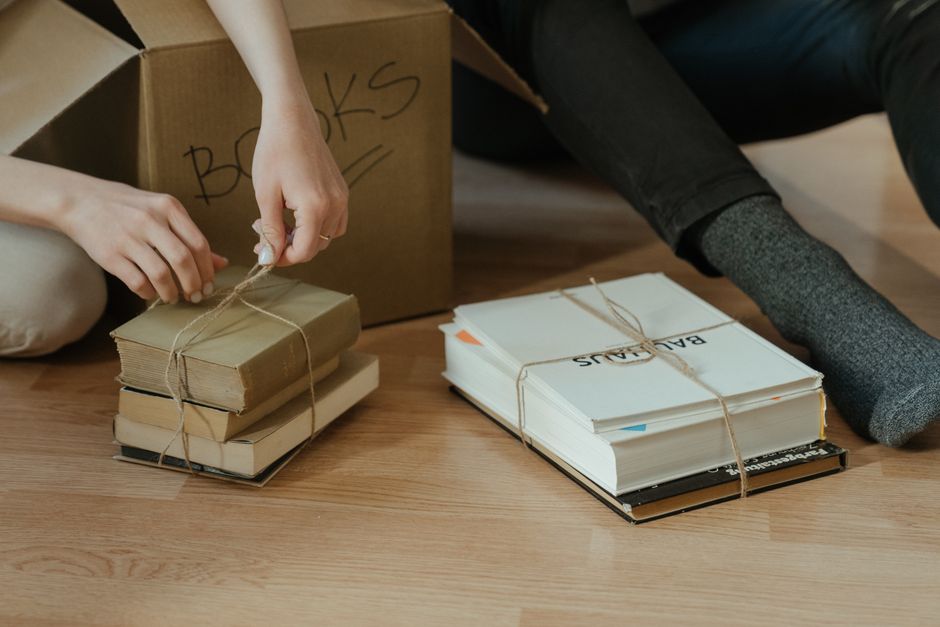
Books can be packed in three orientations: spine down (upright, as they sit on a shelf), spine facing the box side (on their side in a stack), or flat. Spine-down packing works well for standard paperbacks and small hardcovers in small boxes. For larger hardcovers, stacking flat — covers facing up, no more than four or five books per layer — is the safest option for the binding. The one orientation to always avoid is spine up with pages facing down; this puts stress on the binding along the spine edge and can cause permanent warping.
Fill voids and keep boxes manageable
After books are placed, fill any remaining voids with crumpled packing paper so nothing shifts in transit. Shifting inside a box is what causes corners to catch on neighboring books and bends dust jacket edges. Seal the bottom of every book box with at least two strips of tape running in both directions — book boxes fail at the bottom more than anywhere else. Write the section or category on the top and one side of each box, and add a number so boxes can be unpacked in sequence if that matters for your shelving system.
Separate your high-value books from general collection
Any book you would be genuinely upset to lose — signed copies, first editions, antique bindings, rare out-of-print volumes — should be set aside early in the packing process and handled separately. Wrap each one in a sheet of acid-free tissue paper, then a layer of packing paper, then place it standing upright in a small, clearly labeled box. Consider transporting your highest-value books personally in your own vehicle rather than on the moving truck, particularly for a long-distance move where the truck may experience temperature and humidity changes over multiple days.
How to Pack Artwork, Collectibles, and Non-Book Library Items
The home library almost always contains more than books. Framed artwork, prints, maps, decorative globes, ceramic or metal bookends, collected figurines, magnifying glasses, antique clocks, and other objects are typically woven throughout the shelving and walls — and they require completely different handling from the books around them.
Framed artwork and prints
Every framed item needs a corner protector — either purchased foam corners or improvised ones made from folded cardboard — on all four corners before being wrapped. Wrap the framed piece in a layer of packing paper, then in bubble wrap secured with tape, and pack it in a flat art box or a purpose-built picture box. If you are packing multiple frames in a single box, place a layer of cardboard between each piece and orient them so the glass faces face each other with padding between — this distributes any pressure safely. Label each box "FRAGILE — DO NOT LAY FLAT" and stand them on edge in the truck, leaned against a wall, never stacked flat with items on top.
Globes, bookends, and decorative collectibles
Decorative globes are often more fragile than they appear, particularly vintage models where the surface is a paper or vellum overlay on a plaster or cardboard base. Wrap globes completely in bubble wrap, securing the wrap so it does not slip, and pack them in a box with crumpled paper on all sides — the globe should not be able to shift in any direction when the box is closed. Ceramic bookends, figurines, and similar items each need their own bubble-wrap wrapping and their own section of a box, separated from other objects by packing paper walls. Never assume that two ceramic items packed close together but not touching are safe — boxes flex in transit, and items that were not touching when packed can be in contact by the time the truck arrives.
How to Handle Library Furniture: Bookcases, Ladders, and Seating
Library furniture presents its own distinct set of challenges. Tall bookcases are top-heavy and unstable once emptied, and their finish — whether painted, stained, or lacquered wood — is easily scratched by wall contact, strap edges, or contact with other furniture in the truck. Before any piece of furniture leaves the room, it needs to be fully prepared for transport.
Disassembling bookcases
Remove all shelves before attempting to move the bookcase unit. Individual shelves are far easier to transport than the assembled piece, and moving a tall bookcase with shelves still inside creates an unpredictable weight shift that can cause the case to tip. Keep all shelf pegs, pins, bolts, and hardware in a labeled zip-lock bag taped to the back panel of the bookcase itself — this is the single most reliable way to ensure the hardware is present when reassembly begins. If you have a built-in bookcase that was partially disassembled when you moved in, consult any documentation from that installation before attempting to take it apart again.
Rolling library ladders
A rolling library ladder on a rail system needs to be assessed before moving day. In most cases, the ladder itself can be dismounted from its rail — check for a stop bracket at one end of the rail that allows the roller hooks to be lifted free. Wrap the ladder in moving blankets, paying particular attention to the top hook hardware and the wheel axle brackets. The rail should be unscrewed from the wall or shelf unit and transported flat, wrapped in a blanket, secured so it cannot shift. Keep all rail mounting hardware in a labeled bag.
Reading chairs, ottomans, and other seating
Upholstered seating from the library should be wrapped in stretch wrap — not blankets alone — to keep the fabric clean during transit. Avoid plastic wrap that traps moisture against fabric for extended periods on long-distance moves; in that case, breathable moving blankets secured with stretch wrap on the outside are the better option. Wooden leg and arm components are scratch-vulnerable; wrap exposed wood in packing paper before applying the blanket.
Creating a System That Makes Unpacking Efficient
The difference between a library that is functional within a week of moving and one that takes months to reconstruct almost always comes down to the labeling and documentation decisions made before the first box was packed. A home library is one of the rooms where post-move organizational debt compounds most quickly — each day spent without a functioning shelving system makes it harder to find what you need and easier to simply leave boxes stacked against the wall indefinitely.
Before you begin packing, photograph every shelf from a distance that captures the full section, and then photograph smaller groups of books so that titles are legible. Number your shelves on a piece of tape — shelf 1, shelf 2 — so that boxes can be labeled to correspond. When boxes are labeled with the shelf section they came from and the sequential order they should be unpacked in, reassembly becomes a straightforward process rather than a reconstruction puzzle. For very large libraries, a simple spreadsheet or notes app entry for each shelf section takes an hour to create and saves many hours on the other end.